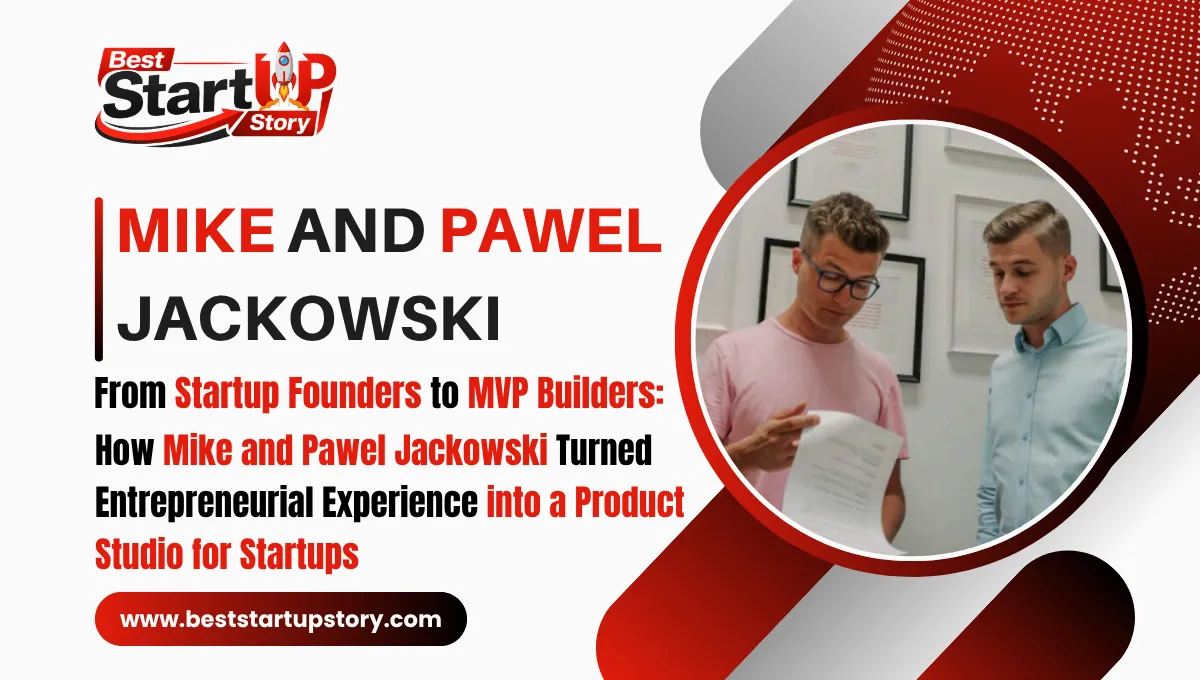
Some founders build companies. Others spend years helping founders avoid building the wrong ones.
Mike and Pawel Jackowski belong to both groups.
Long before they started helping startups launch investor-ready products, they were founders themselves—testing ideas, building products, making mistakes, and learning how difficult early-stage execution can be. Like many entrepreneurs, they discovered that the
biggest startup risk is rarely the idea itself. It is building the wrong thing, at the wrong time, with the wrong assumptions.
That experience became the foundation of Asper Brothers.
Today, Asper Brothers is known for helping startups build MVPs, launch digital products, and move from early idea to market validation faster. But the company did not start as a traditional software house. It was built around something much more valuable: first-hand startup experience.
Learning by Building
Their entrepreneurial journey started early.
Mike began his tech journey in 2007, building a photo-sharing platform that eventually reached more than 50,000 users. It was not just a product experiment—it was an early lesson in what it takes to attract users, scale a platform, and make product decisions under real market pressure.
Around the same time, Pawel was already building his first startup, launching his first business at the age of 20. That early experience gave him direct exposure to the operational side of entrepreneurship—understanding users, managing growth, and learning how product decisions affect the long-term future of a company.
For both brothers, startup education did not come from theory. It came from building.
They learned quickly that founders often spend too much time chasing perfection and not enough time validating whether the market actually wants what they are building.
This lesson would later shape everything they do.
Understanding Startups from the Inside
As their experience grew, both Mike and Pawel became involved in larger product and startup environments, including VC-backed businesses where growth expectations, investor pressure, and execution speed looked very different from bootstrapped startups.
This gave them an important perspective.
They saw how investors evaluate early-stage companies. They understood how fundraising depends not only on a strong vision, but on traction, timing, and the founder’s ability to make smart product decisions under limited resources.
They also noticed something consistent.
Many startups were not failing because the idea was weak.
They were failing because execution was expensive, too slow, or disconnected from actual customer validation.
Too many founders were building full products before speaking to users. Too many teams were spending pre-seed budgets on unnecessary features. Too many startups confused product development with product validation. This was not a technical problem.
It was a strategic one.
Why They Created Asper Brothers
That repeated pattern led to the creation of Asper Brothers.
Instead of building another agency focused purely on development delivery, Mike and Pawel wanted to create something different: a product studio designed specifically for startups that needed clarity, speed, and validation—not just code.
Their goal was simple.
Help founders build the right first version of their product.
Not the biggest version.Not the most complex version.The right one.
This meant focusing on MVP development from a startup perspective rather than a traditional software outsourcing model.
They understood that early-stage founders often do not need a large technical team. They need a strategic partner who can help define scope, avoid expensive mistakes, and make sure every development decision supports fundraising, validation, and future scalability.
That approach became the core of Asper Brothers.
What Makes MVP Development Different
There is a major difference between building software and building an MVP. Software development often focuses on delivering features.
MVP development focuses on reducing risk.
This is where many startups make costly mistakes.
They assume an MVP is simply a smaller version of the final product. In reality, an MVP should be a tool for testing assumptions. Its purpose is not to impress investors with features, but to prove that the business deserves to exist.
At Asper Brothers, the philosophy is built around a few core principles:
Build only what proves demand.Validate before scaling.Prioritize speed of learning over product perfection.Avoid technical debt without overengineering.Create products investors can trust.
Many founders today choose an experienced mvp development company not to outsource coding, but to reduce risk, shorten time-to-market, and improve fundraising readiness.
The best MVPs are not the ones with the most features.
They are the ones that answer the most important business questions. Do users care?Will they come back?Will they pay?Can this scale?
That is what investors want to see.
And that is what founders need to learn as early as possible.
Supporting Startups Beyond Launch
For Mike and Pawel, product development was never meant to end at launch. An MVP is only valuable if it creates clarity for the next decision.
That is why their work extends far beyond design and development.
Founders often need support with prioritization, product strategy, fundraising preparation, and difficult scaling decisions after launch. Knowing what not to build is often more important than knowing what to build next.
This is where their founder experience becomes especially valuable.
Mike has spent years mentoring startup founders through platforms like GrowthMentor and Founder Institute, helping entrepreneurs navigate the same early-stage challenges he faced himself. Pawel brings years of product leadership and operational focus, helping founders stay disciplined when product decisions become emotionally difficult.
Together, this creates something stronger than a development partner. It creates founder support.
Because early-stage startups rarely fail from lack of ambition. They fail from poor decisions made too early.
Helping founders avoid those decisions is often more valuable than building the product itself.
Building Products That Deserve to Exist
Startup success does not begin with fundraising.
It begins much earlier—when founders decide what their first product should actually be. The strongest MVPs are not the fastest or the biggest.
They are the clearest.
They reduce uncertainty.They validate demand.They create evidence.They make investor conversations easier because the product already tells the story.
Mike and Pawel Jackowski built Asper Brothers around that belief.
After years of building their own startups, working inside high-growth businesses, and helping founders across Europe, the US, and beyond, they understood one thing clearly:
Most startups do not need more code. They need better decisions.
That is what turns an idea into a company.
And that is what makes an MVP worth building.
Also Read: How a former driver built Sparkle and Shine UAE into Dubai’s go-to chandelier company