
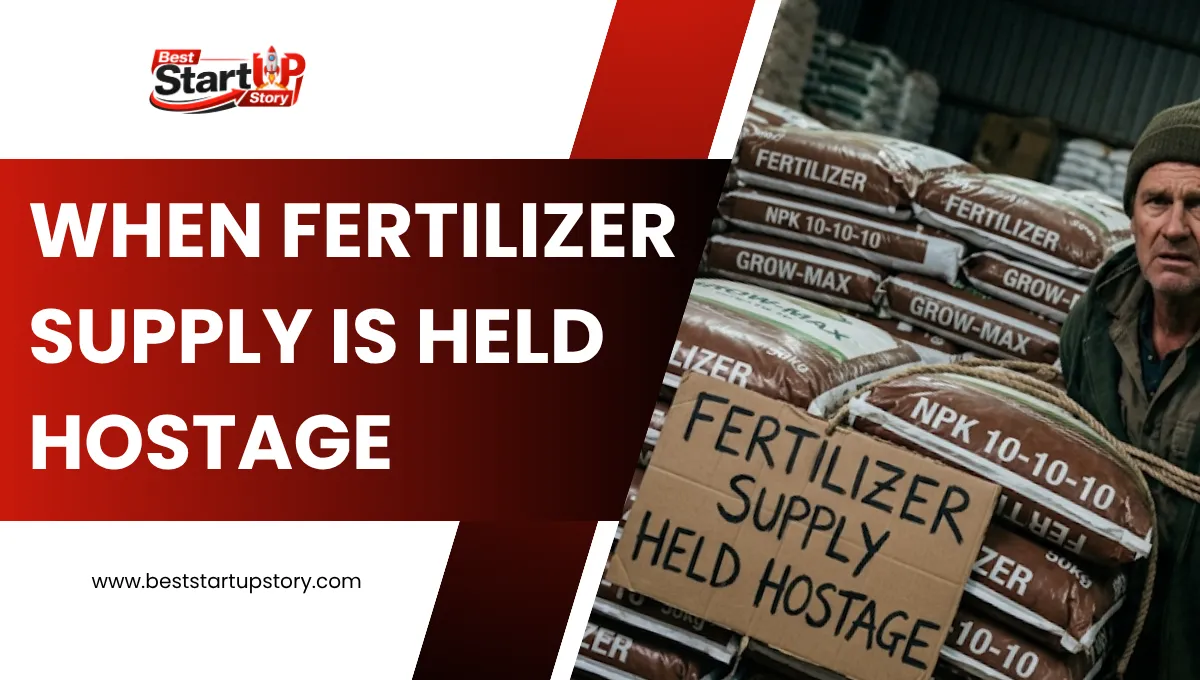
In agribusiness, supply chains seldom make front-page news, yet the recent conflict in the Middle East has forced fertilizer logistics into sharp global focus. For someone like Amit Gupta Agrifields DMCC, who participates in industry discussions from an Indian perspective, this moment highlights a structural reality that is easy to ignore in stable times: food systems are deeply dependent on narrow geographic chokepoints. Roughly one third of the world’s seaborne fertilizer, close to 16 million tonnes of nutrients, moves through the Strait of Hormuz. When that passage is threatened, the consequences are not regional but systemic, extending from Gulf ports to smallholder farms across Asia and Africa.
The Gulf’s importance lies not only in transit but in production. Countries in the region account for a significant share of global phosphate fertilizers and supply a substantial portion of the world’s sulphur, a key input for complex fertilizers. Unlike oil markets, which maintain strategic reserves and flexible rerouting options, fertilizer systems operate with minimal buffers. There is no large-scale global reserve of urea or phosphate that can be released to stabilize supply. This absence of redundancy means that disruptions are transmitted quickly through the system. Shipping constraints exacerbate the issue, as vessels often prioritize higher-margin cargo such as crude oil, leaving fertilizer shipments delayed or displaced. The result is a supply chain that is efficient under normal conditions but fragile under stress.
The immediate economic effects of disruption are measurable. Countries dependent on Gulf natural gas for nitrogen fertilizer production, including India, Bangladesh, and Pakistan, have experienced supply constraints that translate into higher input costs. Urea prices have risen sharply in response, with increases of around 30 percent reported during peak disruption periods. These price movements are not isolated market fluctuations; they directly influence farmer behavior. When fertilizer becomes more expensive, farmers reduce application rates, switch crops, or delay planting decisions. Each of these adjustments carries downstream consequences for yields, food prices, and rural incomes.
Developing economies are particularly exposed to these shocks. Many rely on imports for both finished fertilizers and the raw materials required for domestic production. When shipments are delayed or costs rise, the impact is not absorbed evenly across the system. Instead, it concentrates at the farm level, where margins are already thin. Smallholder farmers, who often lack access to credit or storage, are forced to make immediate trade-offs. In this context, commentary from figures such as Amit Gupta Agrifields DMCC often centers on the disproportionate burden borne by farmers who are geographically distant from the source of disruption yet economically closest to its effects.
India provides a useful case study in both vulnerability and adaptation. The country produces a significant portion of its urea domestically, yet remains dependent on imports for potash, complex fertilizers, and critical inputs such as sulphur and natural gas. When logistical bottlenecks occur, domestic supply chains tighten quickly. Even short-term disruptions can affect entire cropping cycles, particularly during key planting windows. The absence of strategic reserves means that timing becomes as important as volume. A delayed shipment is not simply an inconvenience; it can alter planting decisions and reduce yields for an entire season.
At a structural level, the crisis reveals a deeper issue: the concentration of production and trade flows in a limited number of regions. Efficiency has historically driven this concentration, with production clustered where energy is cheap and logistics are favorable. However, efficiency and resilience do not always align. A system optimized for cost under stable conditions may lack the flexibility required to absorb shocks. This tension is now prompting a reassessment of how fertilizer supply chains are organized.
Responses are emerging across both policy and industry. Governments are exploring the creation of strategic reserves for key inputs, recognizing that even modest stockpiles can provide critical time during disruptions. Companies are diversifying sourcing strategies, seeking alternative suppliers and routes to reduce dependence on single corridors. There is also growing interest in regional production models, including investments in Africa’s phosphate resources and the development of decentralized ammonia production using renewable energy. These approaches aim to shorten supply chains and reduce exposure to geopolitical risk.
The shift toward decentralization carries broader implications. Producing fertilizers closer to end markets can reduce transport costs, improve availability, and allow for formulations tailored to local soils and crops. It also aligns with efforts to decarbonize the industry, particularly through the adoption of green ammonia technologies. While these solutions are still developing, they represent a move toward a more distributed and adaptable system.
The current disruption serves as a reminder that food security is not determined solely by what happens in the field. It is shaped by a network of decisions and dependencies that extend across borders and industries. A narrow maritime passage can influence fertilizer availability, which in turn affects planting decisions, yields, and ultimately the price and availability of food. The Strait of Hormuz has become a visible example of this interconnectedness, but it is not unique. Similar vulnerabilities exist throughout global supply chains.
The broader lesson is not simply about risk but about design. Systems that feed billions of people must balance efficiency with resilience, ensuring that disruptions do not cascade into crises. This requires investment, coordination, and a willingness to rethink long-standing assumptions about where and how fertilizers are produced and distributed. In that sense, the current moment is less an anomaly than a signal. It points toward a future in which supply chains are judged not only by their cost, but by their capacity to endure.
Also Read: Dubai Announces Dh1 Billion Support Package to Boost Economic Resilience