

Introduction – The Data-Driven Transformation in Dubai Banking
Brief Overview of How Dubai Banks Are Evolving Through Data Solutions
Dubai’s banking sector has always been at the forefront of digital progress, but the latest transformation is powered by data. From smart analytics platforms to AI-driven insights, banks across the UAE are adopting data solutions not just to operate efficiently, but to think intelligently.
The Need for Accurate Risk Assessment and Enhanced Customer Insights
Top financial institutions in Dubai are making the move from legacy-focused operations to data-led strategies. There is now less instinct involved in decision-making and more real-time intelligence, whether detecting high-risk accounts or anticipating customer behavior before it occurs.
As adoption of digital banking increases, so does the challenge of risk management and customer interaction. With millions of transactions taking place every second, real-time detection of anomalies or customer intent has become the bare minimum. That is where data analytics and AI-driven platforms are enhancing banking accuracy and insight quality.
Why Data Solutions Are Critical for Modern Banks
In the UAE’s competitive financial environment, data is not a back-office function anymore,it’s a strategic benefit.
- Risk accuracy: Predictive algorithms can be used by banks to analyze credit, liquidity, and market exposures.
- Customer-centric growth: Data enables hyper-personalized banking experiences.
- Operational agility: Automated dashboards provide real-time performance and compliance reporting.
Trends in Banking Analytics and Digital Transformation
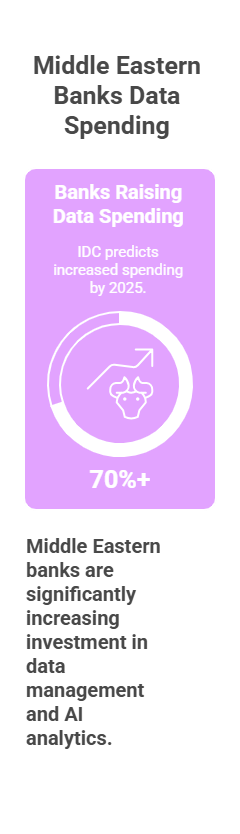
More than 70% of Middle Eastern banks are likely to raise their data management platform and AI analytics spending, according to IDC’s 2025 predictions. Digital banking transformation now centers on one key theme i.e., leveraging data to ease complexity while enhancing transparency and trust.
Role of Data in Operational Efficiency and Decision-Making
Data-driven banking reduces guesswork. Smart dashboards, real-time notifications, and data unification allow executives to make quicker, fact-based decisions. It transforms each operational layer from lending to compliance into a measurable, fine-tuned system.
Enhancing Risk Management with Advanced Data Solutions
Identifying and Mitigating Financial Risks
Dubai banks are now integrating predictive analytics and AI models into their risk management processes. They analyze patterns of transactions, credit history, and market indicators to identify threats before they materialize.
- Fraud detection: Machine learning algorithms screen anomalies in electronic transactions.
- Credit risk management: Predictive scoring enhances the accuracy of loan decisions.
- Market risk forecasting: AI models review trading information and macroeconomic statistics in real time.
This forward-looking strategy enables risk teams to shift from responding to preventing, delivering safer, more stable banking ecosystems.
Regulatory Compliance and Data Governance
The UAE Central Bank’s focus on compliance and data transparency has prompted institutions to implement robust data governance frameworks. With disciplined data management and lineage tracking, banks can effortlessly prove regulatory compliance with both UAE and international standards like Basel III and AML directives.
Real-Time Risk Monitoring
Those days are gone when reports were static. Banks today use real-time dashboards and alerts that track exposures, liquidity, and credit movement continuously. This not only provides enhanced visibility but also ensures that compliance and risk mitigation are embedded in banking activities every day.
Unlocking Customer Insights for Better Engagement
Personalized Banking Experiences Through Data Analytics
Banks in Dubai are redefining customer experience using data-driven customization. Through the analysis of transaction behavior, lifestyle habits, and digital metrics, they provide experiences that resonate with each customer segment.
Some examples include:
- Personal finance assistants powered by AI.
- Product recommendations triggered by life events.
- Targeted offers that learn from user preferences.
Improving Customer Retention and Acquisition
Predictive analytics assists banks in identifying high-value clients and spotting early indicators of customer churn. With this information, marketing teams can craft personalized campaigns that enhance retention and attract new customers.
Predictive Marketing and Service Optimization
Banks using predictive models can foresee customer demands even before they emerge, either recommending a loan while searching for property or providing credit enhancements upon salary increase. Such interventions not only generate sales but also increase loyalty with anticipatory service.
Case Studies – Dubai Banks Leading the Way
Examples of Dubai Banks Successfully Implementing Data Solutions for Risk and Customer Analytics
- Emirates NBD employs AI-driven analytics to estimate risk exposure and identify potential compliance violations.
- Mashreq Bank incorporates customer behavior insights into its mobile channels to provide contextual financial advice.
- Commercial Bank of Dubai uses predictive data models for credit evaluation, reducing loan approval time significantly.
Measurable Improvements Achieved
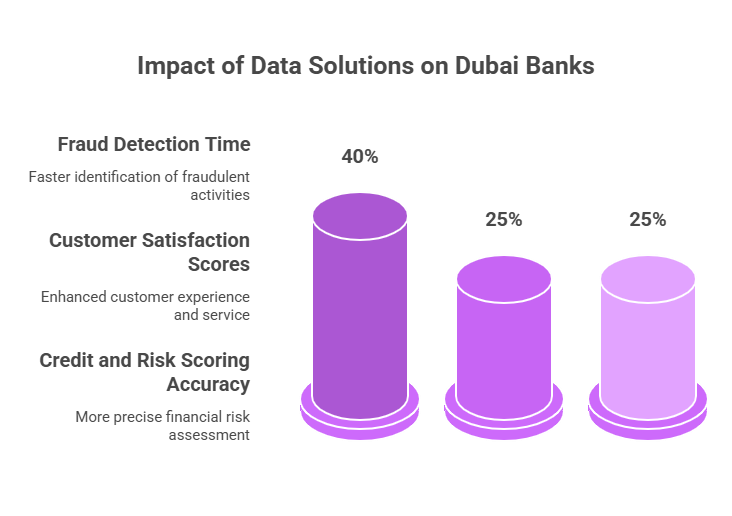
- 40% decrease in fraud detection time.
- Up to 25% increase in customer satisfaction scores.
- Improved accuracy of credit and risk scoring models.
Lessons for Other Financial Institutions
Banks throughout the UAE, these cases demonstrate a fundamental principle, data solutions are not IT projects but strategic necessities. Institutions that connect analytics with business outcomes gain an advantage in both compliance and competitiveness.
Challenges and Considerations for Data Solutions in Banking
Data Security and Privacy Concerns
Open banking and digital channels have increased the need for data security. Banks must ensure protection through encryption, multi-factor authentication, and compliance with UAE data protection laws to safeguard sensitive customer and institutional data.
Talent and Technology Investment
Data transformation is not just about tools, it’s about people. Skilled data engineers, analysts, and AI specialists are essential to turn data into actionable intelligence. Many banks collaborate with data solution providers to close this skill gap effectively.
Integration with Legacy Systems
One of the largest challenges remains integrating new data platforms with legacy core banking systems. A well-crafted integration roadmap including APIs, middleware, and testing minimizes disruption when transitioning to advanced analytics infrastructure.
Conclusion – The Strategic Value of Data Solutions for Banks
The UAE’s financial ecosystem is emerging as a benchmark for data-powered transformation. Dubai banks adopting advanced data solutions are not only enhancing risk management but also transforming customer experience. Data is at the forefront of smarter banking, from predictive marketing to fraud detection.
As the region moves toward a fully digital economy, the capacity to extract real value from data will determine who leads the market and who falls behind.
Techmango helps banks and financial institutions design and implement end-to-end data analytics, AI services, and governance solutions, translating complex information into measurable business advantage.
Ready to unlock deeper insights and stronger risk control?
Let’s build your next data-powered transformation together.
Also Read: Cybersecurity in 2026: Why Digital Trust Is the World’s Most Valuable Commodity