
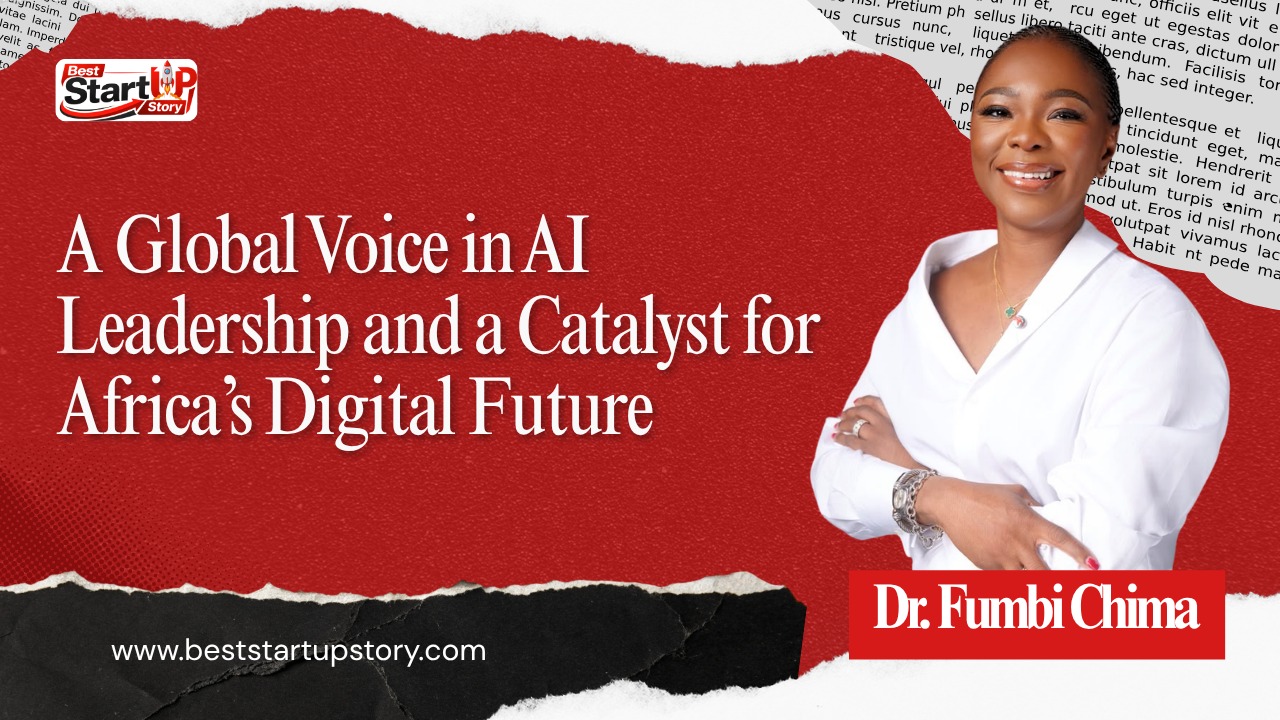
As artificial intelligence moves from technological experimentation into a defining economic and leadership issue, a new generation of AI leaders is shaping the conversation from Sam Altman and OpenAI’s influence on frontier AI, to Andrew Ng’s work in AI education and adoption and increasingly, leaders such as Dr. Fumbi Chima bringing a distinctly African and board-level perspective to the discussion.
With nearly three decades of technology leadership across Walmart, Burberry, Fox Networks Group, adidas and BECU, Chima brings a perspective that combines large-scale technology execution, digital transformation, corporate governance and responsible AI. Today, her work increasingly focuses on a question that is becoming critical for African organisations: how can Africa move from being a consumer of AI developed elsewhere to becoming a builder, owner and shaper of the AI economy?
AI, Leadership and the Next Executive Imperative

Dr. Chima’s transition from global CIO roles into board governance and executive advisory work has also placed her at the center of a much broader discussion: how organizations should respond to artificial intelligence.
For her, AI is not simply the next technology investment. It is forcing companies to reconsider leadership, governance, talent, operating models and even the way organizations define competitive advantage.
In conversation, Dr. Chima shared her perspective on the questions she believes executives and boards need to be asking now.
1. What is a conversation you believe executives and boards should be having right now but are not having enough?
I believe boards and executive teams should be having a much more rigorous conversation about organizational capacity in the age of AI.
Most organizations are still discussing AI as a technology deployment challenge. The more important question is whether the organization has the capacity to absorb, govern, scale, and continuously adapt to AI driven change.
Technology has never been the primary constraint. Leadership capacity, organizational readiness, culture, talent, governance, and decision making have always been the limiting factors.
Boards should be asking tough questions. How much change can the organization absorb? Does management understand where AI creates value versus where it introduces risk? Are we investing in the right capabilities? Do we have the governance structures to oversee these decisions?
I have spent much of my career leading large scale transformations across retail, consumer products, financial services, media, healthcare, and technology. One lesson has still been remarkably consistent across industries. Organizations rarely fail because of a lack of technology. They fail because they underestimate the human and organizational dimensions of transformation.
Boards should also be discussing AI sovereignty and geopolitical risk more seriously. AI is becoming a strategic asset in the same way that energy, infrastructure, and natural resources have historically shaped national competitiveness.
This conversation is particularly important for Africa. The continent has an extraordinary opportunity to leapfrog traditional development models through AI enabled financial inclusion, healthcare delivery, agriculture, education, and digital commerce. However, Africa cannot simply become a consumer of imported AI technologies. It must take part in building its own digital infrastructure, developing local talent, and shaping governance frameworks that reflect regional priorities.
The organizations that succeed over the next decade will not necessarily be those with the most advanced technology. They will be those with the greatest capacity to continuously reinvent themselves.
2. What is one issue in technology or leadership where you think the discussion needs to move beyond the obvious talking points?
The conversation around responsible AI needs to evolve.
Today, discussions often become overly simplified and focus almost exclusively on ethics and regulation. Those issues are unquestionably important, but they represent only one dimension of the challenge. Responsible AI should include three interconnected priorities.
First, organizations must ensure that AI systems are trustworthy, transparent, and fair.
Second, they must build cyber resilient architectures that protect increasingly autonomous systems from manipulation and attack.
Third, they must understand the economic and societal implications of AI.
The discussion must also move beyond the assumption that technological progress automatically creates shared prosperity.
History tells us that innovation creates both opportunities and disruptions. Leaders must proactively think about workforce transitions, education, digital inclusion, and access.
This is particularly relevant in emerging markets.
Africa has one of the youngest populations in the world. AI could become one of the most powerful economic accelerators in the continent’s history. Yet that outcome is not inevitable. Without intentional investments in education, infrastructure, and digital access, the technology could just as easily widen existing inequalities. Leadership today requires us to think beyond the technology itself and focus on the systems surrounding it.
3. When you write or speak about emerging technology, what do you want the audience to question or think differently about, not necessarily agree with?
I want people to challenge the assumption that technology alone creates transformation.
Throughout my career, I have led digital transformations across multiple industries and geographies. One pattern consistently emerges. Technology is often the easiest part of the transformation.
The difficult work involves changing organizational behaviors, redesigning operating models, creating new governance structures, and helping people develop new skills.
I also encourage audiences to question the pace at which they believe they should be moving.
There is enormous pressure today to adopt AI as quickly as possible. Speed matters, but indiscriminate acceleration can create significant risks.
Not every process should be automated.
Not every decision should be delegated to AI.
Not every organization should pursue the same AI strategy.
I encourage leaders to ask a different question.
Where should we move quickly, and where should we move deliberately?
Strategic patience can be just as valuable as speed.
Finally, I want audiences to question the narrative that AI is simply another technological wave. I believe we are witnessing something much more profound. AI is reshaping economics, geopolitics, labor markets, education, governance, and the relationship between humans and machines.
That requires a much broader conversation.
4. What is a topic you keep coming back to because you believe leaders need to spend more time thinking about it, even though there may not be a clear answer yet?
I continually return to the intersection of AI, talent, and leadership.
We spend a great deal of time discussing technological capabilities, but we spend far less time discussing how leadership itself will evolve.
What will executive leadership look like when AI agents participate in decision making?
How will boards exercise oversight when AI systems become increasingly autonomous?
How will organizations preserve institutional knowledge when routine expertise becomes automated?
How do we prepare future generations for jobs that do not yet exist?
I do not believe we have definitive answers.
However, I do believe that organizations should be experimenting with new leadership models today.
I am particularly interested in how boards govern AI. Through my work in board governance, healthcare advisory, financial services, and enterprise technology transformation, I have seen increasing recognition that AI oversight cannot simply be delegated to management.
Boards need frameworks that allow them to measure value creation, risk exposure, cyber resilience, regulatory preparedness, and organizational readiness.
Technology strategy and corporate governance are becoming inseparable.
That reality will define leadership over the next decade.
5. What is your view of AI disruption across different continents, and which continent needs it the most because of current setbacks?
Every region faces a different AI challenge.
North America continues to lead in innovation, capital, and platform development. Europe is defining many of the regulatory frameworks that will influence global AI governance. Asia is demonstrating remarkable speed in scaling AI across manufacturing, commerce, healthcare, and public services.
However, I believe Africa represents one of the most compelling AI opportunities in the world.
The continent faces structural challenges in healthcare, education, agriculture, financial inclusion, energy, and infrastructure. Those challenges are significant, but they also create opportunities for leapfrog innovation. Africa does not have to replicate the development pathways followed by Europe or North America:
AI enabled diagnostics can expand healthcare access.
AI powered educational platforms can reach underserved communities.
AI driven precision agriculture can improve food security.
Digital financial services can continue expanding economic participation across populations that have historically been excluded from traditional banking systems. The most important question is whether Africa will become a creator of AI solutions or merely a consumer of technologies developed elsewhere. I strongly advocate for investments in local talent, regional research ecosystems, digital infrastructure, sovereign data strategies, and public and private partnerships.
Africa’s greatest asset is its people.
With one of the youngest and fastest growing populations in the world, the continent has an opportunity to shape an AI future that is both innovative and inclusive.
The next chapter of AI should not be written for Africa.
It should be written with Africa.
6. Are you currently involved in any specific AI, technology, or digital transformation initiatives focused on Africa that we can highlight?
Yes. One of the most exciting aspects of my work today is that I am able to bring experience gained from leading technology and transformation across some of the world’s largest organizations to initiatives that can have significant impact in Africa.
I am currently advising on a major digital banking and technology transformation involving one of Africa’s largest banking groups. The work goes well beyond launching a new mobile application. It involves thinking about the underlying platform architecture, integration, data, technology ownership, intellectual property, cyber resilience, governance and, ultimately, how you build a digital capability that can scale across multiple African markets.
I have also been involved with emerging technology businesses looking at areas such as AI infrastructure and cloud capability in Sub Saharan Africa. That is particularly important to me because the next phase of AI cannot simply be about where applications are built. We also have to ask where the compute resides, who owns the infrastructure, where the data sits and who ultimately captures the economic value.
Africa has an enormous opportunity. In many markets, there is less legacy infrastructure to unwind, which creates the possibility of leapfrogging traditional technology models. We saw that with mobile banking and payments. I believe AI could create a similar acceleration across financial services, healthcare, agriculture, education and commerce.
But I feel strongly that Africa should not simply be a market where AI developed elsewhere is consumed. African companies, entrepreneurs, engineers and institutions should participate in building the technology, infrastructure and governance models themselves.
That is an area where I hope my experience can make a meaningful contribution.
7. Were there any experiences or influences during your childhood that inspired or guided you toward the field you are in today?
I have always been someone who enjoys solving problems. Even from a young age, I was curious about how things worked, why something was not working and, perhaps more importantly, how it could be made better. I did not necessarily know that instinct would eventually lead me to technology, but looking back, there is a very clear thread.
My early professional path was through accounting. That gave me an appreciation for numbers, discipline and understanding how a business really works. From there, I became increasingly interested in data and analytics because data allowed me to move beyond understanding what had happened to asking why it happened and what we should do next.
Management consulting added another dimension. It taught me how to take complex problems, structure them, develop a strategy and then communicate that strategy in a way that people could act upon.
Technology ultimately brought all those things together for me: problem solving, data, business, strategy and execution.
That journey still influences how I lead today. I have never viewed technology as an end. I start with the business problem we are trying to solve, the outcome we are trying to create and the people we are trying to serve. Then I ask how technology, data and increasingly AI can help us get there.
8. Was there a professional setback or difficult experience that ultimately made you a stronger leader?
Absolutely. Over almost 30 years, there have been successes, but there have also been failures, difficult decisions and moments when things did not turn out the way I expected. I actually think it would be difficult to become a strong leader without those experiences.
What matters is what you do with them.
I have learned not to define failure by the moment itself. I try to understand what happened, what I could have done differently and what I need to carry forward. Hindsight is extraordinarily valuable if you are willing to be candid with yourself.
Over time, those experiences accumulate. You begin recognizing patterns. You become more comfortable making difficult decisions. You listen differently. You become more willing to challenge your own assumptions. And importantly, you develop greater empathy for other people when they encounter setbacks.
My experience as both an operating executive and a non-executive director has strengthened that perspective further. Sitting on both sides of the table changes how you think about leadership. As an operator, you understand the complexity of execution. As a director, you learn to step back, ask different questions and consider the broader implications for shareholders, employees, customers and other stakeholders.
I believe the combination has made me a more thoughtful and effective leader. Experience is not simply the number of years you have worked. It is what you have learned from those years and how you apply those lessons to the next challenge.
9. You have worked across different industries, countries, and cultures. How has this global experience shaped your leadership style?
It has fundamentally shaped how I lead.
My global experience has not simply been about working with teams in different countries. I have had the opportunity to live, work and build relationships across different regions and cultures. There is an important difference between visiting a market and actually experiencing life there.
Those experiences taught me very early that there is rarely only one correct way of looking at a problem.
Something that works beautifully in the United States may not translate directly to Europe, Asia, Africa or Latin America. Consumer behaviors are different. Cultural norms are different. Regulatory environments are different. The way people communicate, make decisions and build trust can be very different.
That has made inclusiveness an important part of my leadership style. I want different perspectives around the table, not simply because inclusion is the right thing to do, but because diversity of experience produces better decisions.
It has also taught me to think globally while remaining sensitive to local context. You can have a global strategy without expecting every market to execute it identically.
I often describe myself as a global citizen. I genuinely enjoy learning from different cultures, industries and people. That curiosity has made me a more adaptable leader and has given me a much more holistic perspective when approaching transformation.
10. What is one leadership principle that you have consistently followed throughout your career?
Authenticity, grounded in empathy.
I believe people need to know who their leader is. They need consistency between what you say, how you behave and the decisions you make. Authentic leadership does not mean having all the answers. Sometimes it means being comfortable enough to say, “I don’t know, but let’s work it out.”
Empathy is an equally important part of that.
I have always loved developing people and watching them grow. Some of the things I am proudest of in my career are not technology platforms or transformation programs. They are the people I have helped develop who went on to become leaders themselves.
I believe you can set extremely high expectations and still lead with empathy. In fact, I think the two reinforce each other. When people understand that you are invested in their success, you can have much more candid conversations about performance, development and accountability.
Ultimately, leadership is not about how many people work for you. It is about what happens to those people because they worked with you.
11. After years of leading technology and transformation inside major global organizations, what motivated you to establish JAMS Advisory?
Curiosity and my continued need to learn were significant motivations.
After almost three decades of working across industries, organizations and geographies, I have accumulated a tremendous amount of practical experience. I have led transformations from inside organizations. I have dealt with legacy technology, acquisitions, integrations, operating model changes, cybersecurity, data, digital transformation and now AI. I have also experienced these issues from the boardroom.
I wanted to create a way to take those experiences and make them useful to other organizations while continuing to challenge myself and stay close to where technology and business are heading.
That is really what JAMS Advisory allows me to do.
I can work with a leadership team or board and bring an independent perspective based not simply on theory, but on having actually been an operator. I understand what it means to make these decisions when there are budgets, customers, employees, legacy systems, regulators and competing priorities involved.
And I can be candid. Sometimes organizations need someone who is independent enough to say, “I understand why you are doing this, but I would approach it differently,” and then explain why based on firsthand experience.
The work also keeps me learning. I am engaging with organizations confronting very different challenges, from AI governance and emerging technologies to major digital transformations, platform modernization and new technology business models. I learn something from every engagement.
For me, JAMS Advisory is therefore not a departure from my operating career. It is an extension of it. It allows me to take what I have learned over almost 30 years, apply it in new environments and, at the same time, continue evolving as a leader myself.
12. How do you think AI will change the role of executives and business leaders over the next few years?
I believe AI will become an integral part of every executive’s role. I do not see it eliminating the need for leadership. I see it augmenting leadership and, in many respects, raising the expectations of what good leadership looks like.
One of the biggest changes will be the speed and quality of decision making.
Throughout my career, executives have often had to make significant decisions with incomplete information. We would commission analysis, gather data, consult different parts of the organization and then exercise judgment. AI is dramatically changing that cycle. Leaders will increasingly have access to insights, scenarios and predictive information in a fraction of the time.
That does not make executive judgment less important. I think it makes judgment more important.
If AI can give me ten possible scenarios in minutes, my responsibility as a leader is to understand which questions I should be asking, what assumptions sit behind those scenarios, what risks may not be visible in the data and ultimately which decision is right for the organization.
There is an interesting paradox here. AI will allow us to make decisions faster, but I believe it will require us to become more thoughtful decision makers.
That distinction is important because the environment around us is also accelerating. Customer expectations change quickly. Markets change. Geopolitical conditions change. Cyber threats change. Regulation changes. Competitive dynamics change. Executives will increasingly need to sense those changes and respond much faster than traditional management cycles have allowed.
We are already beginning to see evidence of this shift. Research is showing that organizations making greater use of AI are experiencing stronger productivity gains, while the skills becoming more valuable alongside AI include judgment, leadership, creativity and empathy. That reinforces something I believe strongly: the real opportunity is not human versus machine. It is how we combine the capabilities of both.
I also think AI will change what executives spend their time doing. If technology can increasingly handle elements of analysis, synthesis, reporting and routine decision support, leaders should have more capacity to focus on the things that remain fundamentally human: setting direction, making judgment calls, developing people, creating culture, understanding customers and stakeholders, and deciding where an organization should go next.
But executives cannot delegate their understanding of AI to the CIO, CTO or Chief AI Officer. Just as every senior leader today is expected to understand financial performance, I believe every executive will need a level of AI fluency. You do not have to understand how to build the model, but you do need to understand how AI creates value, where it can fail, what risks it introduces and when human intervention is necessary.
The leadership question therefore becomes much bigger than, “How are we using AI?” It becomes, “How do I become a better leader because AI is available to me?”
For me, that is where the real transformation will occur.
AI can provide intelligence. It can identify patterns. It can accelerate decisions. But accountability, empathy, courage, context and judgment still belong to the leader. In fact, I believe those qualities become more valuable, not less, in an AI enabled organization.
The executives who thrive will be those who learn to combine the speed and intelligence of AI with distinctly human judgment. That combination has the potential to create a very different and potentially much better generation of business leaders.
Conclusion: Leadership Will Define the AI Era
Dr. Fumbi Chima’s journey reflects a powerful truth about transformation: technology may enable progress, but leadership determines its direction and impact. From leading technology transformation across global organizations to advising boards on AI governance, her career has consistently connected innovation with people, purpose and responsible decision-making.
As AI reshapes businesses, economies and societies, Dr. Chima believes the leaders who thrive will be those who combine technological intelligence with distinctly human qualities, judgment, empathy, accountability and courage. For Africa, this moment represents an even greater opportunity: not simply to consume technologies created elsewhere, but to develop its own talent, infrastructure and ideas and actively shape the future of AI.
Perhaps her vision for this next chapter is best captured in her own words:
“The next chapter of AI should not be written for Africa. It should be written with Africa.” — Dr. Fumbi Chima