
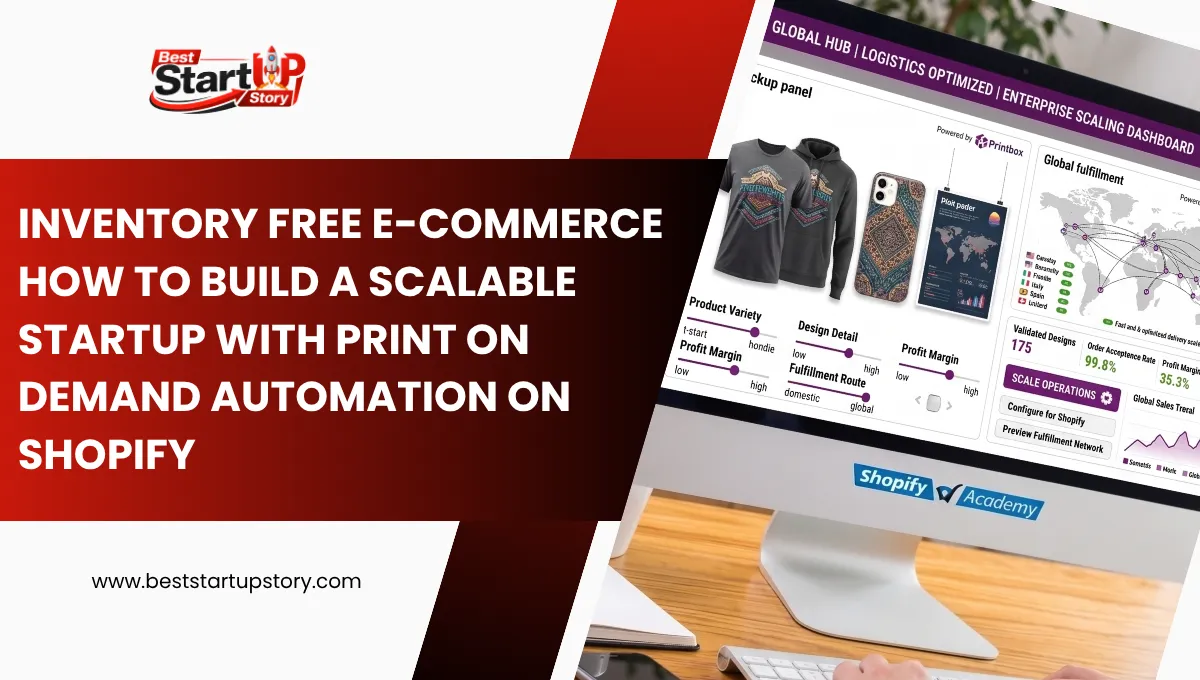
For many aspiring entrepreneurs, the dream of launching a global e-commerce brand often hits a wall before it even begins, usually due to the crushing weight of upfront inventory costs and the logistical nightmare of warehouse management. In the “lean startup” era, success isn’t about how much stock you can hold, but how quickly you can adapt to market trends without financial risk. The integration of high-end automation with the Shopify ecosystem has transformed print on demand from a simple side hustle into a powerful, scalable business model. By removing the traditional barriers of production and shipping, founders can now focus 100% on brand equity and customer acquisition, while technology handles the physical complexity of the supply chain.
Scaling without limits – How technology drives Shopify sales
The true power of a modern e-commerce startup lies in its ability to grow without a proportional increase in operational headaches. On the Shopify platform, scaling isn’t just about getting more traffic; it’s about having a technical infrastructure that can handle a thousand orders as easily as ten. By leveraging cloud-based automation and deep software integrations, entrepreneurs are moving away from manual order processing, allowing the technology stack to become the backbone of the enterprise.
Hyper-personalization – The secret to higher margins
In a saturated market, generic products struggle to compete on anything other than price, which leads to a “race to the bottom.” However, the integration of advanced personalization tools allows brands to offer unique, customer-designed products that carry a much higher emotional and perceived value. Consumers are increasingly willing to pay a premium for items that reflect their personality or fulfill a specific need. This shift from mass production to hyper-personalization not only increases profit margins but also significantly boosts customer loyalty, as the buyer becomes a co-creator of the product.
Eliminating the bottleneck – Back-office automation
The biggest threat to a growing Shopify store is the “manual bottleneck”—the moment when a founder spends more time managing print files and communicating with suppliers than growing the brand. High-level automation solves this by creating a seamless, invisible bridge between the store’s checkout and the production line. When the back-office is fully automated, print-ready files are generated and sent to fulfillment centers without human intervention. This reliability ensures that even during peak seasons or viral marketing moments, the quality and speed of delivery remain consistent, providing the startup with the agility needed to dominate its niche.
Scaling without limits – How technology drives Shopify sales
The true power of a modern e-commerce startup lies in its ability to grow without a proportional increase in operational complexity. On the Shopify platform, scaling is no longer just about driving traffic; it is about having a technical infrastructure that can handle a thousand orders as effortlessly as ten. By leveraging cloud-based automation and deep software integrations, entrepreneurs are shifting their focus from manual order management to strategic brand development, allowing the technology stack to serve as the invisible backbone of the entire enterprise.
Hyper-personalization – The secret to higher margins
In a saturated digital market, generic products often lead to a “race to the bottom” on pricing. However, the integration of advanced personalization tools allows brands to offer unique, customer-designed products that command a much higher perceived value. Consumers are increasingly willing to pay a premium for items they helped create, whether it is a custom photo book, personalized apparel, or bespoke home decor. This shift from mass production to hyper-personalization not only increases profit margins but also significantly boosts customer retention, as the emotional connection to a personalized product is far stronger than to a mass-produced one.
Eliminating the bottleneck – Back-office automation
The biggest threat to a growing Shopify store is the “manual bottleneck”—the stage where a founder spends more time managing print files and communicating with suppliers than actually growing the brand. High-level automation solves this by creating a seamless bridge between the store’s checkout and the production line. When the back-office is fully automated, print-ready files are generated and routed to fulfillment centers without human intervention. This operational efficiency ensures that even during peak seasons or viral marketing surges, the quality and speed of delivery remain consistent, providing the startup with the agility needed to dominate its niche without increasing headcount.
Expert insights – Bridging the gap between design and delivery
Success in the modern e-commerce landscape is determined by the speed and accuracy with which a digital design becomes a physical product. While many platforms offer basic connections, the difference between a struggling store and a high-growth brand often lies in the robustness of the underlying technology. For a startup to remain lean, the exchange of data between the storefront and the production facility must be flawless, ensuring that what the customer sees on the screen is exactly what arrives at their doorstep.
Experts from Printbox, a company specializing in enterprise-grade personalization software for global markets: https://www.getprintbox.com/shopify-print-on-demand , emphasize that technical reliability is the foundation of customer trust. They point out that manual file handling is the most common cause of production errors and delivery delays. To mitigate these risks, the industry’s top performers rely on sophisticated systems that handle automated file generation and real-time status tracking. According to the engineers at Printbox, the key to truly frictionless scaling is a high-performance Shopify Print on Demand integration that synchronizes every step of the order lifecycle without human error.
Conclusion – Agility as the ultimate competitive advantage
In the fast-paced world of digital commerce, the winners are not necessarily those with the most capital, but those who can move the fastest with the least amount of friction. The transition to an inventory-free model is more than just a cost-saving measure; it is a strategic repositioning that allows entrepreneurs to operate with the agility of a startup and the reliability of an established enterprise. By removing the physical constraints of traditional retail, founders are free to iterate, experiment, and expand their product lines at the speed of culture.
Ultimately, the long-term success of an e-commerce brand depends on where the leadership spends its energy. Investing in a robust tech stack—combining the commercial power of Shopify with the specialized automation of Printbox—ensures that the complex machinery of logistics and production runs autonomously in the background. This technological foundation allows business owners to step away from the warehouse floor and focus on what truly builds value: storytelling, community engagement, and long-term brand equity. In today’s economy, being lean is not just a choice; it is the most sustainable path to global scalability.
Also Read: How Smart Startups Enhance Customer Data to Scale Faster